Workshops
A New York workshop, and two official sentences about a brace.
Martin’s official history calls X-bracing an invention. A family account on the same company’s site says it was, they believe, developed over time. Both stay on the desk.
The instrument’s official early history — four courses or six strings, and the modern tuning, kept unblended — is already told on guitar.learntoplay.im. This site is the beginner practice desk. The two desks complement each other and are not copies.
C. F. Martin & Co.’s official history page says the company “has remained family owned and operated” since 1833 — “six generations” — “from a small New York City workshop to Nazareth, Pennsylvania.” [source]
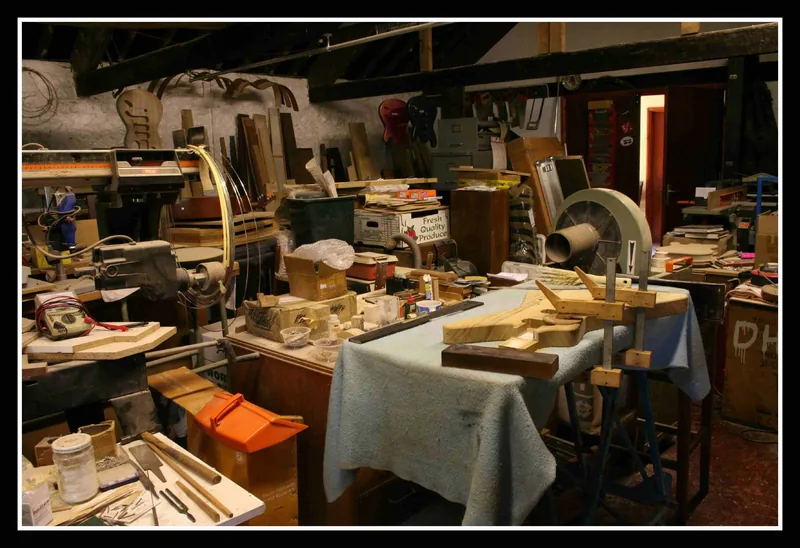
The workshop in the photograph is not that shop. It is the later Devon workshop of luthier Chris Eccleshall, photographed in 2007, and the Commons file title spells the town Buckfstleight. It stands here as a making space, not as Martin’s 1833 workbench.
X-bracing, in two official voices
The same Martin history page says: “Founder C. F. Martin Sr. changed guitar making forever with his invention of X-bracing—a design that gave acoustic guitars their strength and voice.” [source]
A 19 June 2020 Martin page, publishing an excerpt of Chris Martin on his forefathers, uses different wording. Of C. F. Martin Sr., who led 1833–1873, it says: “The development of the now universal X-brace was, we believe, developed over time as a way to create enough structure to hold the top together and produce a very pleasant tone while replacing the traditional fan bracing to accommodate a bridge with bridge pins.” “Invention” on one official page, and “developed over time,” with “we believe,” on the other, are not combined here into a single claim. [source]
The family account also notes “an adjustable neck guitar, built around 1834,” as an interesting early feature. [source]
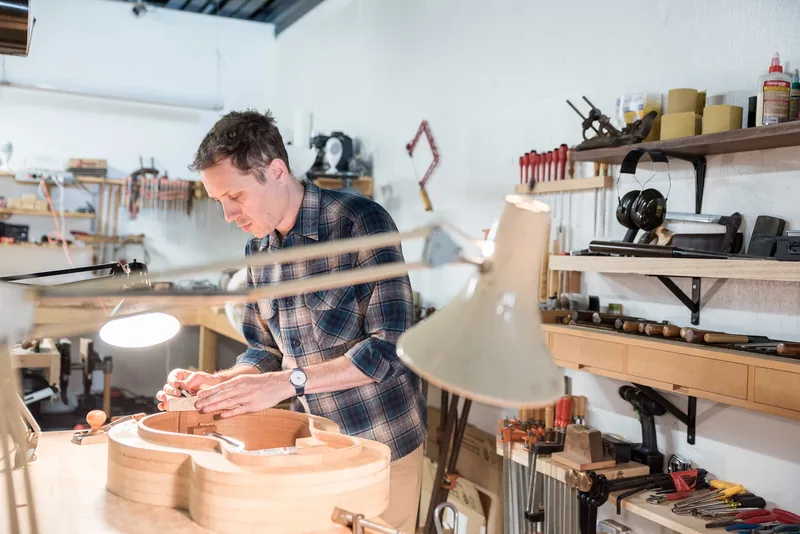
The dreadnought, and a change of strings
The official history page says Martin’s grandson Frank Henry Martin “went on to introduce the Dreadnought, a body style that redefined modern music.” Elsewhere on the same page, a documentary, The Ballad of the Dreadnought, is described as tracing “the guitar’s rise from humble beginnings in 1916.” That 1916 wording is the official page’s description of the film’s story, and is not blended with any other dating of the first dreadnought. [source]
Chris Martin’s 2020 account says that C. F. Martin III and Herbert Keller “joined the business right around the time that we rather quickly stopped using gut strings and started using metal strings,” so that touring musicians could project “to the back of the concert hall.” “This was really the beginning of the western guitar.” The page does not give a single calendar year for that change, so this desk does not invent one. C. F. Martin III’s years of leadership are given there as 1945–1986. [source]
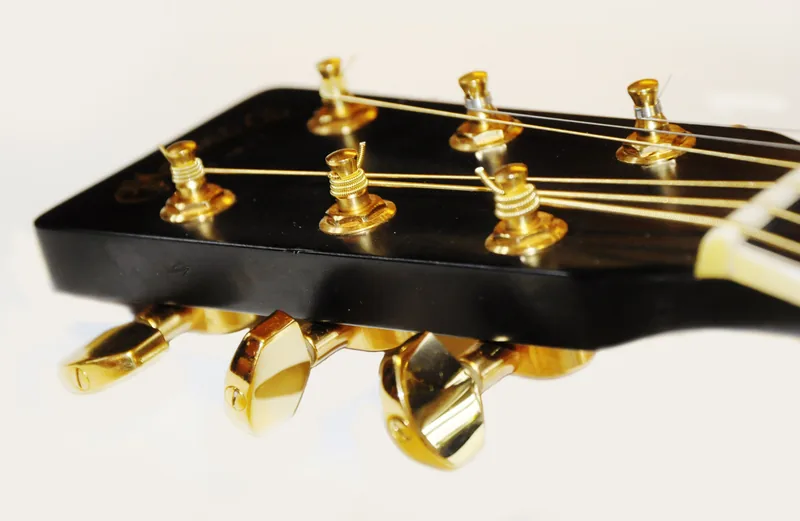
In 1970, the official history says, Martin “acquired Darco Strings and began making our own,” because “strings are the vocal cords of a guitar.” [source]
Early courses of strings, Torres, and the official museum wording for how the modern guitar took shape are told on guitar.learntoplay.im, not repeated here.
Enjoyed a practice desk with working tools, and official firsts kept unblended?
No pop-ups. No intrusive advertising. Just interesting stuff. A little support helps the next ReallyByte site get built.