First folk, and quiet practice
The Guitar of Legends, and a guitar that barely sounds in the room.
Yamaha’s official pages do not all use the same sentence for 1966. This desk keeps each one. The red-label nickname, on Innovation Road, belongs to about 1968 to 1972.
The instrument’s official early history — four courses or six strings, and the modern tuning, kept unblended — is already told on guitar.learntoplay.im. This site is the beginner practice desk. The two desks complement each other and are not copies.
Yamaha’s Innovation Road collection page for the FG180, dated 1966, calls it “Yamaha's first folk guitar, and the first to be manufactured in Japan.” “The superb tones born from Yamaha's superior woodworking technology pleased so many professional musicians at home and abroad,” the same page says, “that the guitar became known as ‘The Guitar of Legends.’” [source]
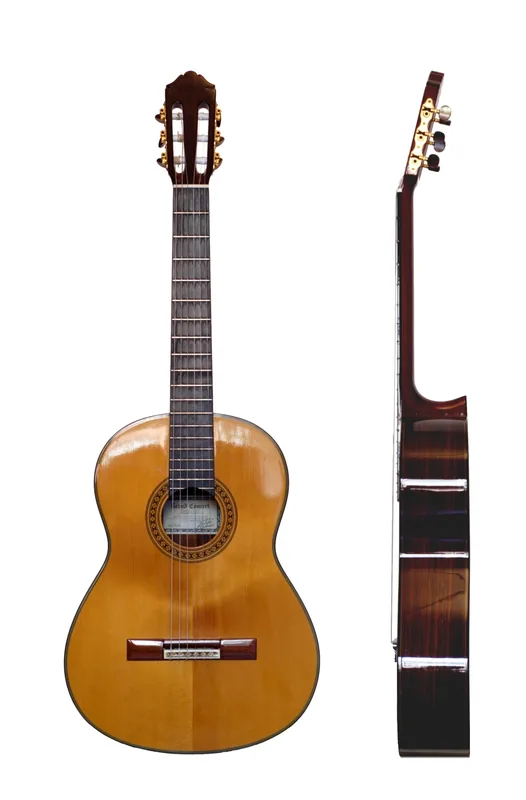
Two official wordings for 1966
Yamaha’s US chronology, written for a sixtieth-anniversary survey, opens with a wider sentence: “In 1966, Yamaha released its very first acoustic and electric guitars and amps.” The same chronology lists the FG180 as “Yamaha's first made-in-Japan folk guitar.” A 2021 Yamaha Hub history says the company “entered the global guitar market in 1966 with the release of the FG180 folk guitar, which was developed using a proprietary design and engineered in-house.” Those three official sentences are close, but they are not the same, so this desk keeps them side by side. [source] [source] [source]
The red label came later
The Innovation Road page is careful about the nickname. “From around 1968 to 1972 the FG-180 featured a red label affixed inside the sound hole, earning it the nickname ‘Red Label,’ and is still popular to this day.” A first FG180, on that official wording, is not automatically a red-label instrument. [source]
The chronology also lists 1972 as the year of the FG350E: “Yamaha's first folk guitar with pickups.” [source]
A guitar for practising without disturbing others
Yamaha later built an instrument whose official point was quiet practice. The chronology lists 2001 for the SILENT Guitar™ SLG100N. The 2021 Hub history, which hyphenates the model as SLG-100N, says that at “the turn of the new century” Yamaha released “the SLG-100N SILENT Guitar™, precursor to today’s line of SLG-200 Series instruments.” “Its ghostly, minimalistic design (like a guitar without a body) delivered ultra-quiet results, allowing players to practice anywhere without disturbing others.” The chronology’s entry for a later SILENT Guitar™ SLG200 says it “is ultra-quiet in the room, but provides a natural-sounding acoustic tone when plugged in.” The year, the hyphen, and which model each sentence describes are left unblended. [source] [source]
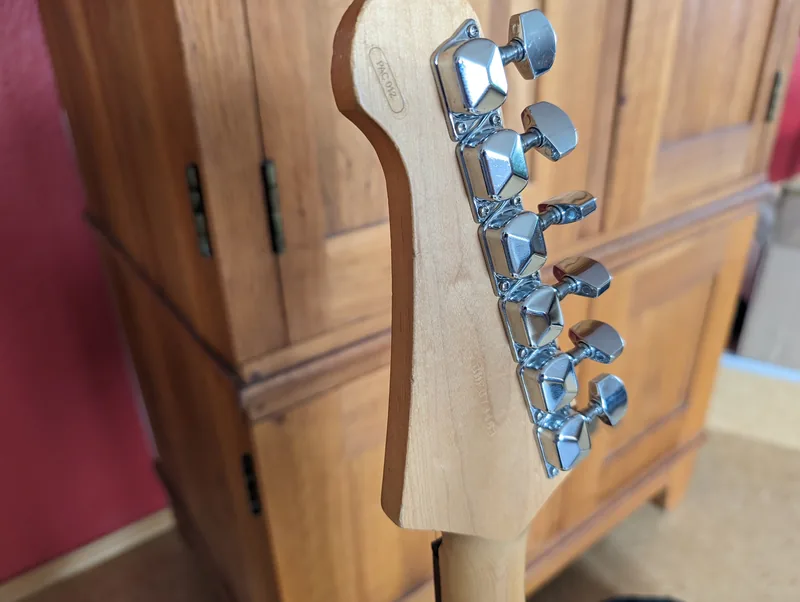
Pacifica, as the official pages put it
The Hub history says the PACIFICA 912, “originally developed in 1990 in partnership with the company’s Los Angeles custom shop, designed to meet the needs of top session players,” later “became a popular choice for both entry-level and advanced players.” The chronology’s shorter wording for 1990 is: “Pacifica912: Yamaha's standard bolt-on guitar still popular today.” The photograph on this page is a Yamaha Pacifica 012 headstock, as its file caption says — a later, different model, not the 1990 Pacifica 912. [source] [source]
Enjoyed a practice desk with working tools, and official firsts kept unblended?
No pop-ups. No intrusive advertising. Just interesting stuff. A little support helps the next ReallyByte site get built.