The click
A compact pendulum, a patent, and more than one spelling.
Official pages give Winkel a fundamental improvement, and Maelzel a patent and a factory. A Science Museum record spells the type Malzel and does not date the object to a patent year.
Beginners still use a click to hold a tempo still. Official pages do not tell one simple inventor story, and they do not even spell the name the same way. This desk keeps the differences visible.
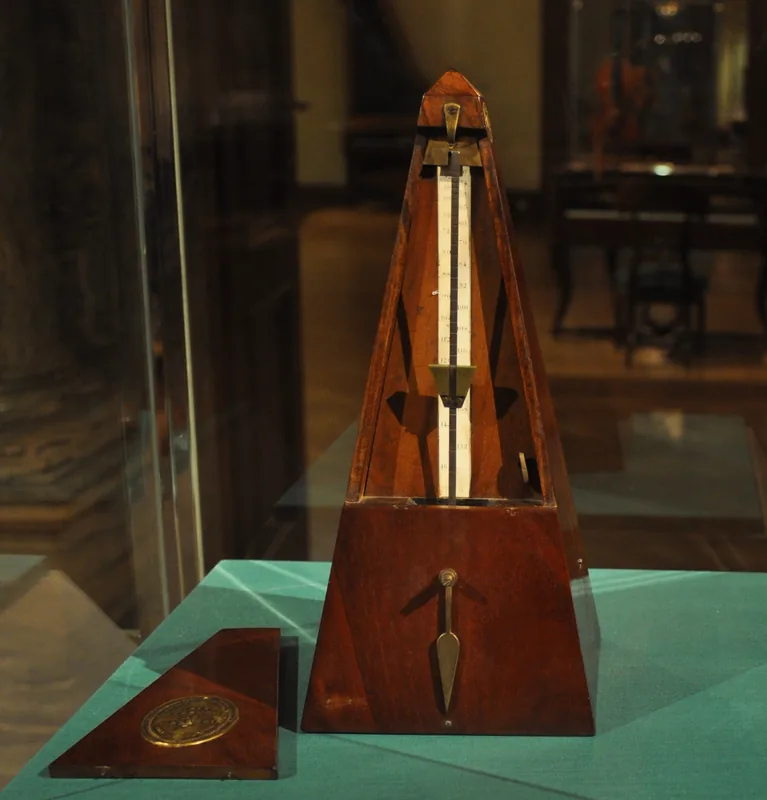
The Museum of Music History on Winkel and Maelzel
A Museum of Music History exhibition page on Johann Nepomuk Maelzel (1772–1838) says that “it is the Dutch mechanic, Winkel, who deserves the credit” for a fundamental improvement of about 1812: a compound pendulum that could give slow rates with a short rod. “A compound pendulum with a rod less than 20cm long can give a range of between 40 and 208 beats per minute.” With clockwork to keep the swing going and to make an audible tick, “all the drawbacks of the Loulié’s chronomètre were overcome.” Winkel’s metronome, the same page says, “is described and commended in the Report of the Netherlands Academy of Sciences (14 August 1815).” [source]
The page then says that Maelzel visited Winkel in Amsterdam, “took from him his idea of the new and superior metronome,” and, after Winkel refused to sell the rights, “patented the new device under his own name.” “Having moved to Paris by 1816, he started what is thought to be the first factory of its kind producing metronomes, the like of which are still in use today.” “Although Winkel later won a case in the Niedeländische Akademie against Maelzel for copying his metronome, credit for its development still goes overwhelmingly to Maelzel.” That last official sentence is left standing beside the earlier credit to Winkel; this desk does not pick a winner. [source]
The same page places an earlier idea in 1696, when “Etienne Loulié had described for the first time a ‘chronomètre’ used to define musical tempi” — a pendulum whose period had to be watched by eye, and which needed almost a metre of length for a beat of 60. [source]
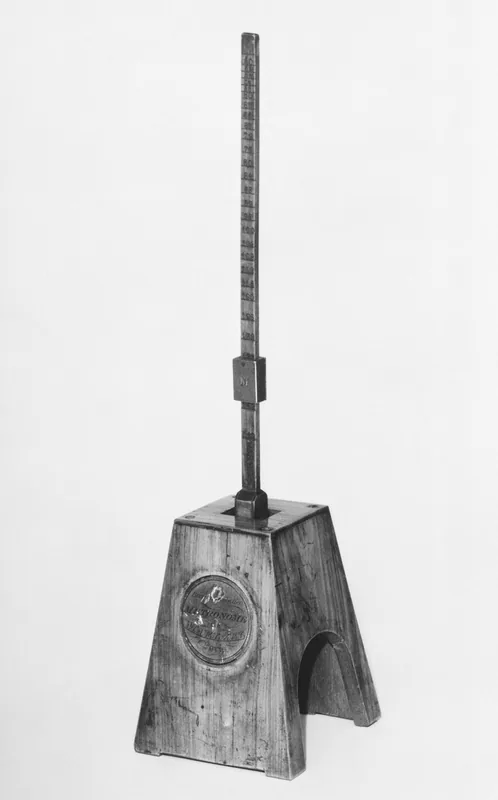
A Science Museum object, and a different spelling
The Science Museum Group collection record for object 1992-195 is titled “Metronome, Malzel type.” The official description is: “Metronome of the Malzel type, with a bell which can sound on every second, third, fourth or sixth beat. Pendulum weight and parts of case missing. French, 19th century.” The museum spells the type “Malzel,” dates the object only as French and 19th century, and does not, on the opened record, give a patent year. That wording is not combined with the Museum of Music History’s 1815 report, or with the 1816 Paris factory date. [source]
The Metropolitan Museum object in the second photograph is described on its file as “French; Metronome; Idiophone-Accessories,” dated circa 1821, with Johann Nepomuk Maelzel named in the artist field. That is a museum object record of about 1821, not a Science Museum “Malzel type” label, and not a dated patent. The first photograph’s file caption says “Paris 1815.” Those two object dates are also left unblended.
What this site’s metronome is not
The browser metronome on this site is a practice aid in the same range of ideas — a click you can set, and an optional emphasis on the first beat, including the 2, 3, 4 or 6 grouping that the Science Museum’s bell could mark. It is not a reconstruction of Maelzel’s or Winkel’s mechanism, and it is not recording-grade synchronisation.
Enjoyed a practice desk with working tools, and official firsts kept unblended?
No pop-ups. No intrusive advertising. Just interesting stuff. A little support helps the next ReallyByte site get built.