Student instruments
A shorter scale, and a path up to a Telecaster.
Fender’s own pages say student electrics were part of the plan almost from 1946, and that the first two went into production in April and June 1956.
The instrument’s official early history — four courses or six strings, and the modern tuning, kept unblended — is already told on guitar.learntoplay.im. This site is the beginner practice desk. The two desks complement each other and are not copies.
Fender’s own history of the Musicmaster and Duo-Sonic says the tradition of offering student-model guitars “began almost as soon as Leo Fender founded the company in 1946.” During that first decade, Leo Fender and sales chief Don Randall “believed in ‘step-up’ sales programs in which students and other beginners could follow a well-defined path of upgraded instruments as their skills grew.” Randall, the same page says, was keen on smaller, less-expensive student instruments for retailers who offered in-store music instruction. [source]
The Telecaster (1951) and Stratocaster (1954), that page says, “were aimed at professionals, but for years there were no related student guitars to naturally lead beginning players to them.” Rock and roll was taking hold; the page notes that “Rock Around the Clock” by Bill Haley & His Comets spent most of summer 1955 on top of the charts. “Randall urged Leo Fender to develop a student electric model around this time, and Leo responded with the Musicmaster and Duo-Sonic, which went into production in April and June of 1956, respectively.” [source]
Short scale, and a price at the low end of the list
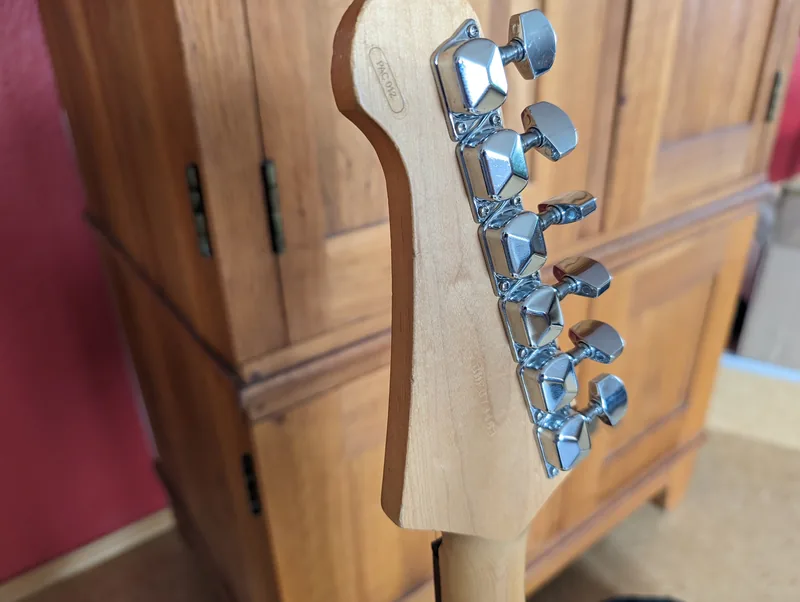
Both original models, Fender says, were short-scale guitars — “22.5 inches compared to 25.5 inches for the Telecaster and Stratocaster” — with slightly smaller bodies, Strat-like headstocks and single-coil pickups. The Musicmaster came first by a couple of months. The Mustang story gives the same scales, and places both student models “at the low end of the price list ($119.50 and $149.50 respectively).” Those are official historic list prices from Fender’s pages, not today’s prices. [source] [source]
The Mustang, August 1964
Fender says it “revamped its student guitar line in 1964” by offering the earlier models in both short and medium (24-inch) scales, “and by introducing an entirely new guitar that August, the Mustang.” Moderately priced at $189.50, the original Mustang “was a dual-pickup, 22-fret, medium-scale guitar that owed much to the Duo-Sonic, although it had an offset waist like a Jazzmaster.” It was “the first Fender student model with a vibrato system.” [source]
The student pages also say, plainly, that while the Musicmaster and Duo-Sonic were aimed at beginners, “in no way were they lacking in the quality present in Fender’s pro-level instruments.” That is Fender’s wording, not a review of a guitar you can add to a basket from this site.
A name that started as Broadcaster
The larger Fender 1950s history is worth knowing if a first electric looks like a Telecaster. Fender says the Broadcaster launched in 1950 as “one of the very first solid-body electric guitars,” then ran into a problem: the name “had already been trademarked by Gretsch.” Labels came off; those guitars “got nicknamed Nocasters.” In 1951, “Don Randall – one of Leo Fender’s first collaborators – suggested the name ‘Telecaster’” because televisions were becoming popular. The same page says the Stratocaster debuted in 1954, with a contoured body, three pickups, and a tremolo arm. Those are professional-line dates on Fender’s own page; the student models came after. [source]
Yamaha’s first folk guitar, and a silent practice guitar
Enjoyed a practice desk with working tools, and official firsts kept unblended?
No pop-ups. No intrusive advertising. Just interesting stuff. A little support helps the next ReallyByte site get built.