Discoveries
Firsts, short scales, and a quiet guitar.
These are official wordings, kept distinct where two pages do not say the same thing.
- Fender says student-model guitars were part of the plan almost from 1946, but the first related student electrics, the Musicmaster and Duo-Sonic, went into production only in April and June 1956. [source]
- Those first student electrics were officially short-scale: 22.5 inches, against 25.5 inches for the Telecaster and Stratocaster. [source] [source]
- The Telecaster was not born with that name. Fender says the Broadcaster of 1950 ran into a Gretsch trademark, and that Don Randall suggested Telecaster in 1951 because of television. [source]
- The Mustang, introduced in August 1964 at $189.50, was “the first Fender student model with a vibrato system.” [source]
- Yamaha’s Innovation Road page calls the 1966 FG180 the first folk guitar, the first manufactured in Japan, and later “The Guitar of Legends.” The red-label nickname, on that page, belongs to about 1968 to 1972. [source]
- Yamaha’s chronology dates a SILENT Guitar™ SLG100N to 2001. A Hub history describes the SLG-100N as allowing practice without disturbing others. [source] [source]
- Two official Martin pages do not use the same wording for X-bracing: “invention” on the history page, “developed over time,” with “we believe,” in Chris Martin’s 2020 account. [source] [source]
- The Museum of Music History gives Winkel the fundamental short compound-pendulum improvement, commended on 14 August 1815, and says Maelzel patented a device under his own name and had a Paris factory by 1816. [source]
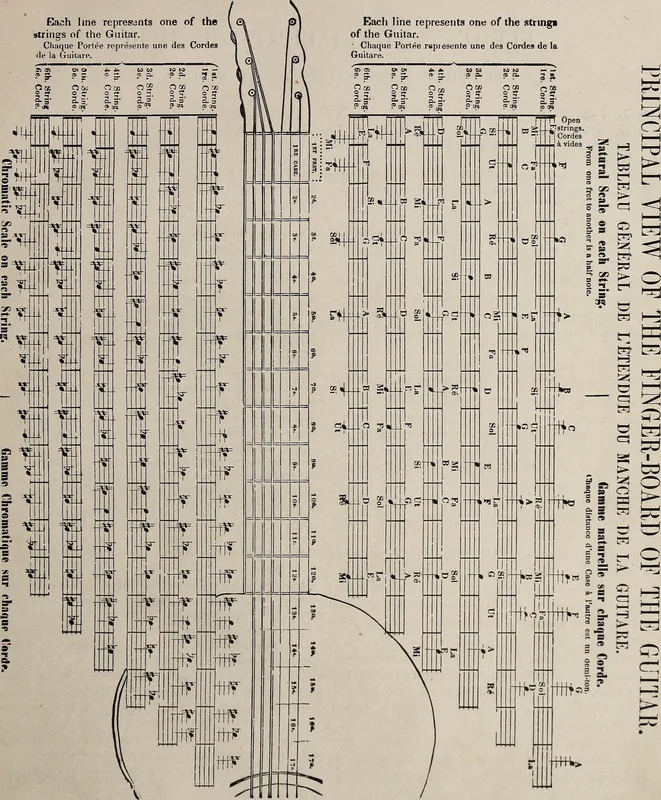
Printed methods are part of how people have learned. The page in the photograph is from Matteo Carcassi’s New and improved method for the guitar, Boston, Oliver Ditson & Co., 1853, as the file records. It is a historic tutor page, not a claim of a first method.
Enjoyed a practice desk with working tools, and official firsts kept unblended?
No pop-ups. No intrusive advertising. Just interesting stuff. A little support helps the next ReallyByte site get built.